
So you're sitting there, staring at that tattoo you got after three tequila shots and a dare from your best friend. Or maybe it's your ex's name in cursive (classic move). Perhaps it's that "profound" Chinese symbol that actually means "soup" instead of "strength." Whatever it is, you hate it, and it needs to go.
Now you're stuck at the crossroads: remove it or cover it up?... It's like choosing between getting your wisdom teeth pulled or getting braces! both involve pain, money, and questioning your life choices.
Both options have their pros and cons. Both will drain your wallet faster than a Vegas weekend. Both require more commitment than your last relationship. But one might be significantly better for YOUR specific case.
So, I'm posting this to help you figure out which path makes sense, because trust me, there's a science to fixing bad ink decisions.
The Quick Decision Tree
Choose removal if:
You're the type who wants a clean slate! Maybe you need that specific spot blank for a future masterpiece. If money flows through your bank account like water and you've got the patience of a Buddhist monk, removal might be your path. This is especially true if your regrettable ink sits on your hands, neck, or face. And if you're absolutely certain you never want another tattoo in that spot, then you should really laser it.
Choose cover-up if:
You still believe in the power of tattoos, just not THAT tattoo. If you're willing to go bigger and bolder (think transforming your tiny rose flower into a majestic phoenix), and your not so rushed to get the results, then cover-ups are your friend. Your wallet will thank you too! plus, if you've found a skilled artist who looks at your disaster and says "I can work with this" with actual confidence, then your good to go.
Choose laser + cover-up combo if:
Your existing tattoo is darker than your soul after watching your team lose the championship. When you've got super dense, super dark ink that would require covering it with basically a black square, then the hybrid approach makes sense. Yes, you'll need both the budget of a small wedding and the patience of a Buddhist monk again, but the results will be worth it.
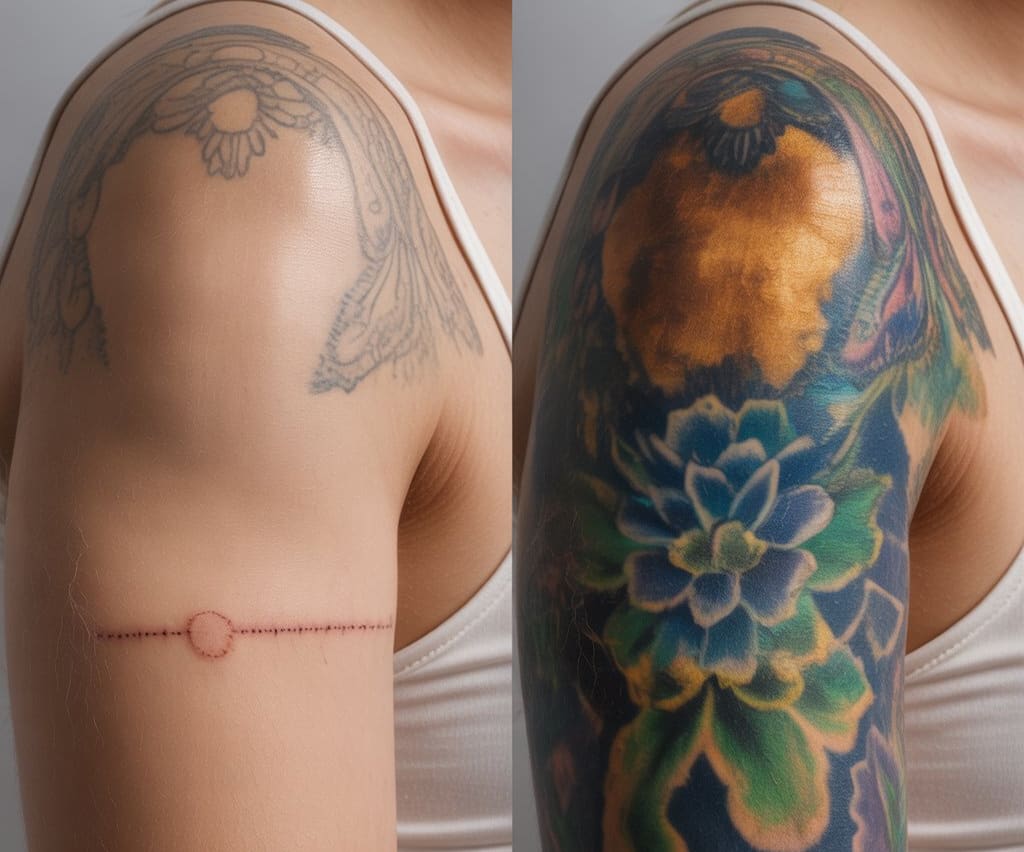
The Full Breakdown: Cover-Ups
What Is a Cover-Up?
A new tattoo strategically designed to hide or incorporate the old one. Think of it like painting over a wall! you need the right colors and design to make the original disappear.
Cover-Up Pros
- Faster. One session (or a few for larger pieces) vs. years of removal.
- Cheaper. Usually $300-2,000 vs. $3,000-15,000 for removal.
- You get new art you love. Instead of blank skin, you get something awesome.
- Less painful overall. One tattoo session vs. 10-20 laser sessions.
- Immediate transformation. Walk out with your new piece that day.
Cover-Up Cons
- Size usually increases. Cover-ups need to be bigger than the original (often 2-3x larger).
- Design limitations. Not every design works for covering. Artist needs to work strategically.
- Darker/bolder necessary. Cover-ups typically need darker ink to hide what's underneath.
- Not all tattoos are coverable. Super dark, dense tattoos might need laser first.
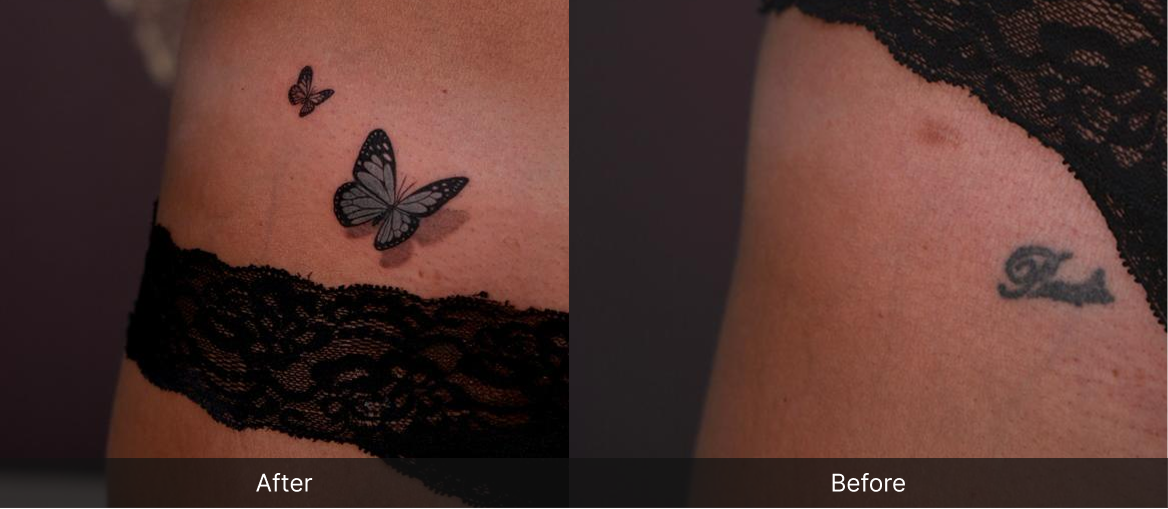
The Process
- Find a cover-up specialist! Not every artist is good at this. Look at portfolios at Tattit Platform and you'r likely to find a good candidate sooner than you expect.
- Consultation. Artist assesses if it's coverable, discusses design options.
- Design phase. They create something that strategically hides the old tattoo.
- The session(s). Get tattooed. Usually takes longer than regular tattoos.
- Healing. Standard tattoo aftercare.
- Touch-up if needed. Sometimes a second session helps perfect coverage.
During the design phase, your artist becomes part engineer, part magician, creating something that strategically hides your old tattoo while still looking intentional. The actual session takes longer than regular tattoos because they're essentially doing a magic trick with needles. After that, it's standard aftercare... keep it clean, moisturized, and away from your curious fingers.
The Full Breakdown: Removal
What Is Laser Removal?
Using laser technology to break up ink particles so your immune system can flush them out. Multiple sessions required.
Removal Pros
- Gets you back to blank skin (mostly... ghosting is common).
- Total design freedom later. No old tattoo dictating your next piece.
- Can target specific elements. Remove just a name, leave the rest.
- Works on any size/location. Even hand/neck tattoos.
- No size increase needed. Your skin returns to normal (ish).
The biggest selling point of removal is the clean slate it offers... well, mostly clean! You get your skin back to its pre-mistake state (though ghosting is common).
The freedom that comes with removal is intoxicating. No more working around that old tattoo like it's a piece of furniture you can't move.
Removal works everywhere, even those job-stopping hand and neck tattoos that seemed like such a good idea when you were "finding yourself." And unlike cover-ups, you don't need to go bigger.
Removal Cons
- Expensive as hell. Often 10x the cost of getting tattooed.
- Takes forever. 12-24+ months for full removal.
- More painful. Laser hurts worse than tattooing for most people.
- Not perfect. Ghosting/shadowing often remains.
- Risk of complications. Scarring, pigmentation changes possible.
Let's talk money! We're talking 10x the cost of getting tattooed, which means that $200 mistake is now a $2,000 problem. It's like paying for college credits you'll never use, except it hurts physically too. Remember how you felt getting that tattoo? Laser removal hurts more...
The Process
- Consultation. Assessment of tattoo and realistic expectations.
- Test patch (sometimes). See how your skin responds.
- Multiple sessions. Usually 8-15+, spaced 6-8 weeks apart.
- Healing between sessions. Each session requires aftercare.
- Long wait. Full process takes 1-2+ years.
The removal journey starts with a consultation where a technician looks at your tattoo and basically tells you how screwed you are (professionally, of course). They'll set realistic expectations, which usually means doubling whatever timeline you had in mind and tripling your budget.
Between sessions, you'll be healing and applying more aftercare products than a beauty model. Each session requires its own recovery period, during which your tattoo might look a bit angry or offended by what you've done to it. The full process takes some time, but thats it anyways.
The Hybrid Option: Laser + Cover-Up
Sometimes the best solution is both.
How It Works
- Laser the tattoo 2-5 times to lighten it significantly (not full removal).
- After adequate fading, get a cover-up tattoo.
- Result: Better coverage with more design options.
When This Makes Sense
- Your original tattoo is very dark
- You want a light-colored cover design
- You want maximum design freedom
- You have the budget and patience
The results are probably best possible cover-up outcome. If you asking if its worth it? the answer is often yes, if you can afford it.
Here you'll see images for one of my clients: before 10 laser removal sessions, after the laser sessions, and after my cover up and retouch:

Common Mistakes People Make
The biggest mistake I see? People choosing the nuclear option of removal when a simple cover-up would work perfectly. It's like buying a new car because you don't like the color of your current one why pay $5,000 and wait 2 years when a good cover-up would solve your problem by next Tuesday?
On the flip side, some brave souls attempt to cover the uncoverable. If your tattoo is truly dark and dense, slapping another tattoo on top is just a bad idea. You'll end up with a bad tattoo on top of a bad tattoo, like putting ketchup on burnt toast. it doesn't help.
Going to non-specialists is another classic blunder. Your cousin's friend who "does tattoos" in his garage is not equipped to handle your cover-up, and that Groupon for laser removal at the mall spa is basically paying someone to hurt you badly. Both cover-ups and removal require actual expertise.
Many people don't even know the hybrid approach exists. Sometimes spending some money on a few laser sessions first is the difference between a mediocre cover-up that looks like you're hiding something and a piece that looks intentional. It's like primer before paint... sometimes, you need it.
And please, for the love of all that is holy, don't make impulsive decisions. Take your time and get consultations from both removal clinics AND cover-up artists. It's like getting multiple quotes for car repair, except this repair is on your body!
How to Actually Decide
Step 1: Search for a cover-up specialist in Tattit and have a chat with them online. See if it's coverable and what designs would work.
Step 2: Get a consultation at a laser removal clinic. Get realistic timeline and cost estimate.
Step 3: Compare:
- Cost difference
- Time difference
- End result you want
- Your budget and patience level
Step 4: Make an informed decision.
There's no universally "right" answer here it's like choosing between coffee and tea when you're hungover. It depends entirely on your situation, budget, timeline, and how much pain you're willing to endure for the sake of erasing your past. So... thanks for reading this...! wish you the best and good luck.